We realize it sounds terribly condescending to tell a professional radiologist exactly how he/she should approach the reading of an exam.
Moreover, experience has shown us that your first reaction to our recommendations will be to roll your eyes, much like you did as a child when your mother told you to eat your vegetables.
Our system, however, is borne of terrible trial and error and error and error. It has been tested and re-tested, over thousands and thousands of cases.
Until you are a fairly experienced PET/CT reader, this system will save your patients from easily made errors — and may potentially save you a painful call to your malpractice attorney.
Certainly create your own reading system, but be wary of doing so until you have gained some experience in this field. What initially might seem like a nuisance may very well become the foundation of your own protocol.
So until that time, please… “Eat Your Vegetables!”
PETCTMD’s 12-STEP READING TECHNIQUE:
- Scout View: Don’t ignore.
- Manually Set Image Intensity:
- Color: Use axial fused images (focus on liver).
- B&W: Use coronal PET images.
- Rotating MIP
- Allows for an overall general assessment, and helps determine how detailed one’s approach to the case will be (are there 3 lesions or 33 lesions?).
- B&W Coronal PET Images
- Quickly use “localizer” for major lesions, briefly identifying findings on the corresponding axial fused images.
- Attention: liver & arms.
- We conclude this step with a “Quick MIP”
- B&W Sagittal PET Images
- Attention: rectum, uterus, & spine.
- We conclude this step with a “Quick MIP”
- BRAIN (B&W Axial Images)
- Must first manually decrease image intensity.
- Axial CT (Soft Tissue Window):
- Read entire body
- Average time spent here: 5-minutes.
- Axial Fused (Soft Tissue Window):
- Read entire body.
- Average time spent here: 10-20 min.
- Axial Fused (Lung Window):
- One lobe at a time, magnified view.
- SKELETON (Bone Window)
- Axial: Top to bottom – Don’t rush or you’ll miss lesions.
- Sagittal: Attention spine, sternum and sacrum.
- Coronal: Attention pelvis, extremities.
- Coronal Fused (Soft Tissue Window)
- Attention: Spleen size.
- Axial Fused (Soft Tissue Window):
- Briefly scroll through images as you dictate case (safety mechanism).
The “12-Step Read” In Action:
Before proceeding to the guts of this course, it is extremely useful to see the actual reading and reporting of one exam using this very specific approach. This will give you a general idea as to the degree of detail and time each part of the exam requires.
To spare your souls, we will condense a normal 20-minute reading process into about 5 minutes. [Video 1]
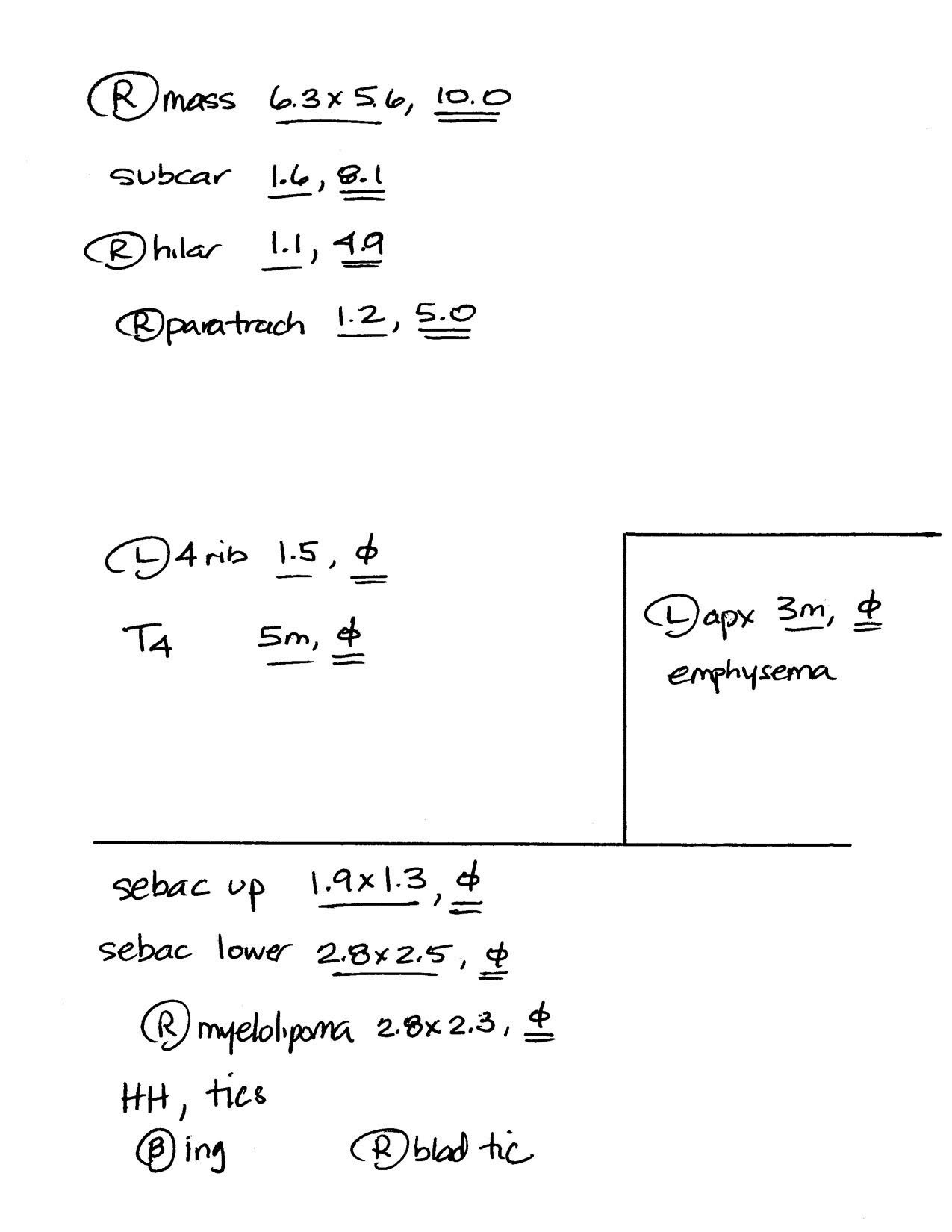
Annotations for this Case:
[Click to open , like the References sections]
Final Report for this Case:
[Click to open , like the References sections]