

Case 1
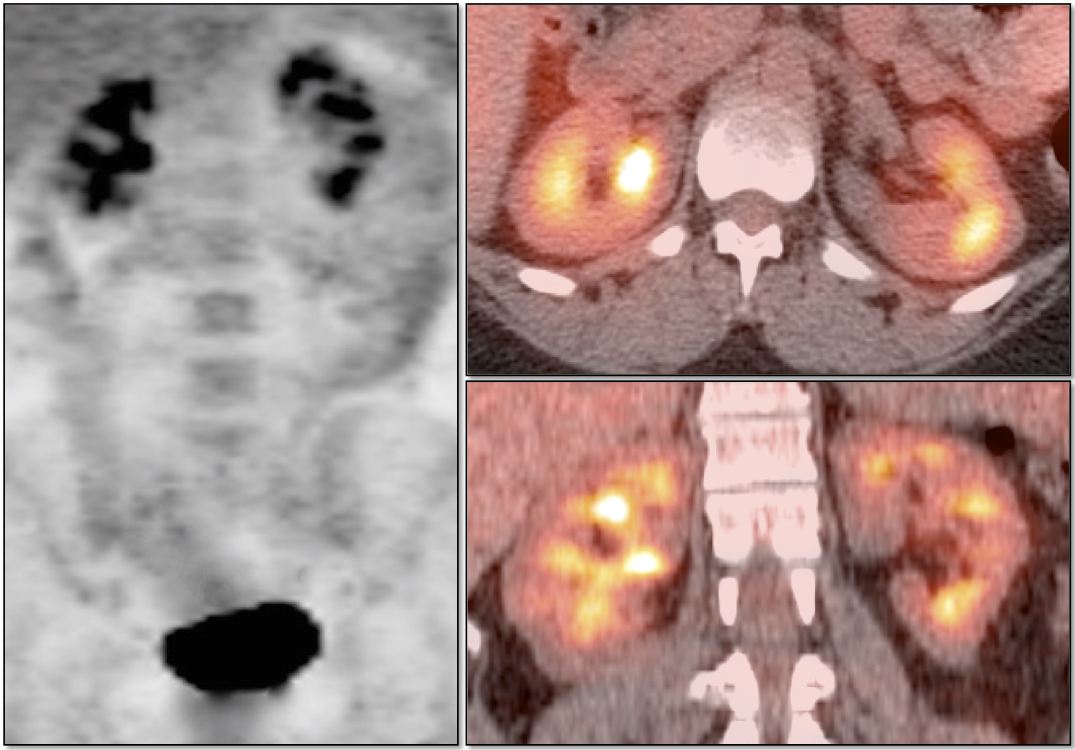
Case 1 (Image 2)
Normal excretion of FDG should not be confused with hydronephrosis or “fullness of the collecting systems”. This uptake can easily mask adjacent renal pathology.
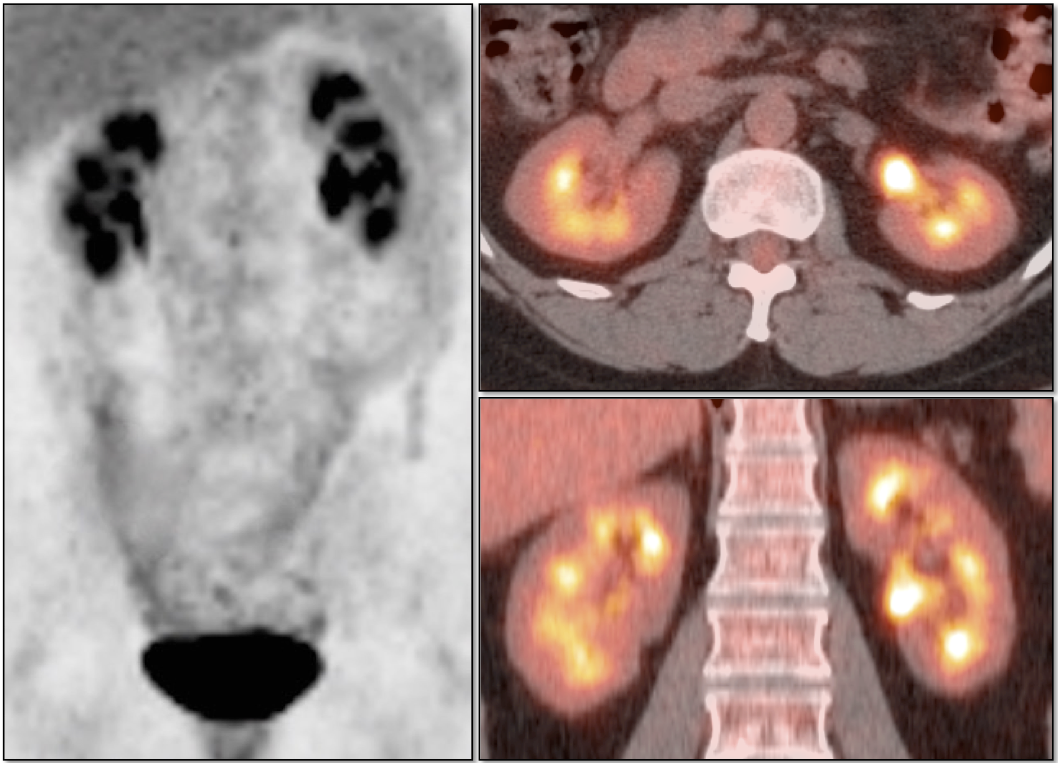
Case 1 (Image 3)
Normal excretion of FDG into the renal collecting systems and renal pelves.

Case 2

Case 2 (Image 2)
Axial images demonstrate a hypermetabolic density involving the lower pole of the kidney. While the CT image is limited without intravenous contrast administration, the density cannot be characterized as a simple cyst (H.U. 58). Its CT appearance and intense FDG uptake are suspicious for a renal cell carcinoma (confirmed at surgery).

Case 2 (Image 3)
Coronal fused image further demonstrates this hypermetabolic renal cell carcinoma involving the lower pole of the kidney.

Case 3

Case 3 (Image 2)
Coronal images demonstrate a density arising from the lower pole of the kidney. While the CT image is limited without intravenous contrast, the density cannot be characterized as a simple cyst (H.U. 42). As renal cell carcinomas can be poorly FDG-avid, malignancy must be excluded in this case. A follow up contrast exam demonstrated an enhancing RCCA.

Case 3 (Image 3)
Axial images reveal the RCCA to be of similar intensity as normal renal cortex (far less intense than the renal collecting system).

Case 3 (Image 4)
Follow up MIP (8-weeks after ablation) demonstrates the renal abnormality to have increased in size. It now demonstrates more intense peripheral FDG uptake.

Case 3 (Image 5)
Coronal image (8-weeks after ablation) demonstrates an FDG-avid soft tissue rim surrounding the now non-avid, partially calcified renal density. This is a common post-ablation appearance of a RCCA. The peripheral uptake is felt to reflect post-ablation inflammatory changes. The lack of metabolic activity within the mass itself suggests successful treatment.

Case 3 (Image 6)
The post-ablation changes seen on the coronal images (Image 5) are confirmed in the axial plane. Note that the FDG uptake is limited to the periphery of this density, suggesting successful treatment.

Case 4

Case 4 (Image 2)
Axial images demonstrate mildly prominent mesenteric lymph nodes. A right renal density is also noted. Although poorly evaluated without intravenous contrast, the renal lesion appears to have soft tissue elements, components of which are mild to moderately FDG-avid (iso-intense to normal renal cortex). A RCCA must be excluded (confirmed at surgery).

Case 4 (Image 3)
Hypermetabolic retroperitoneal lymph node, consistent with recurrence of active lymphoma in this patient.

Case 5

Case 5 (Image 2)
Although the lack of intravenous contrast limits evaluation of the kidney, these sagittal images suggest an intensely avid lesion arising from the upper pole of the kidney, suspicious for a RCCA.

Case 5 (Image 3)
Corresponding axial images again suggest a hypermetabolic renal mass. An intensely avid nodular density is also noted adjacent to the IVC (arrow), poorly evaluated without intravenous contrast.

Case 5 (Image 4)
Coronal fused image demonstrates an intense linear region of FDG uptake extending from the kidney into the IVC. In a RCCA patient, this is most consistent with tumor thrombus (confirmed on a contrast-enhanced follow up exam).

Case 6

Case 6 (Image 2)
Although poorly evaluated without intravenous contrast, axial images suggest a mass arising from the posterior mid-pole of the kidney. It demonstrates regions of intense FDG uptake, suspicious for a RCCA.

Case 6 (Image 3)
Corresponding sagittal images demonstrate the peripheral metabolic activity of this RCCA.

Case 6 (Image 4)
Fused axial image demonstrates a dilated appearance of the left renal vein. Although not significantly avid, it is suspicious for tumor thrombus (confirmed at surgery). An adjacent enlarged metastatic FDG-avid retroperitoneal lymph node is also present (arrow).
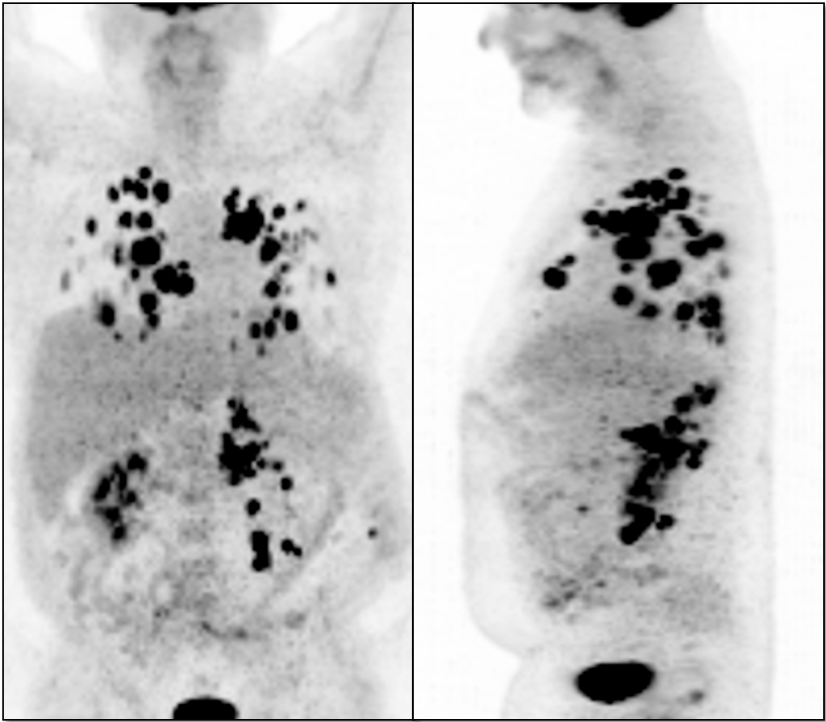
Case 7

Case 7 (Image 2)
Multiple, small FDG-avid metastatic nodular densities in the left renal fossa.
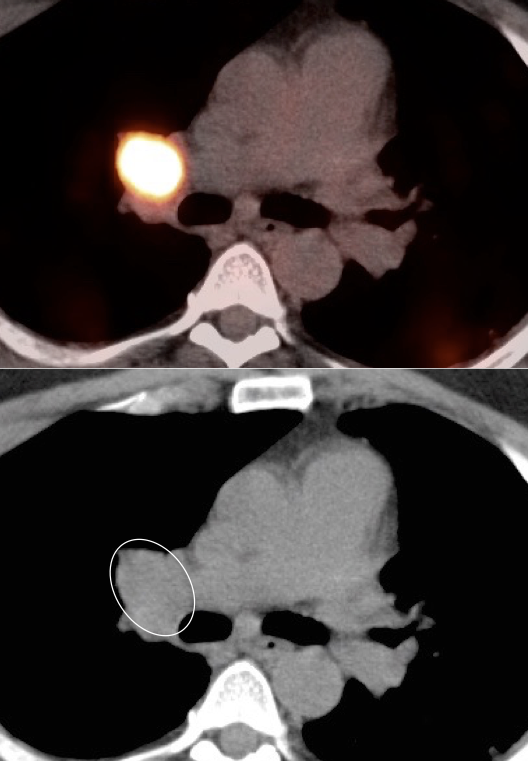
Case 7 (Image 3)
Enlarged and intensely avid metastatic right hilar lymph node.

Case 7 (Image 4)
Intensely avid left retroperitoneal metastatic lymph node (circle). An extremely small FDG-avid omental metastasis is also present (arrow), which could be easily overlooked if this was only a CT scan.

Case 7 (Image 5)
Multiple FDG-avid metastatic pulmonary nodules.

Case 8
Case 8 (Image 2)
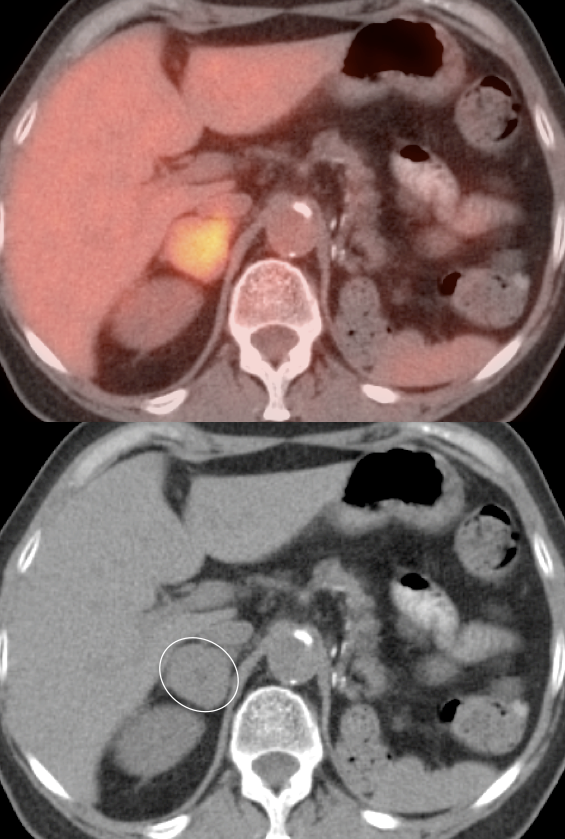
Intensely avid right adrenal metastasis.

Case 8 (Image 3)
Intensely avid metastatic mediastinal and bilateral hilar adenopathy.
Case 8 (Image 4)
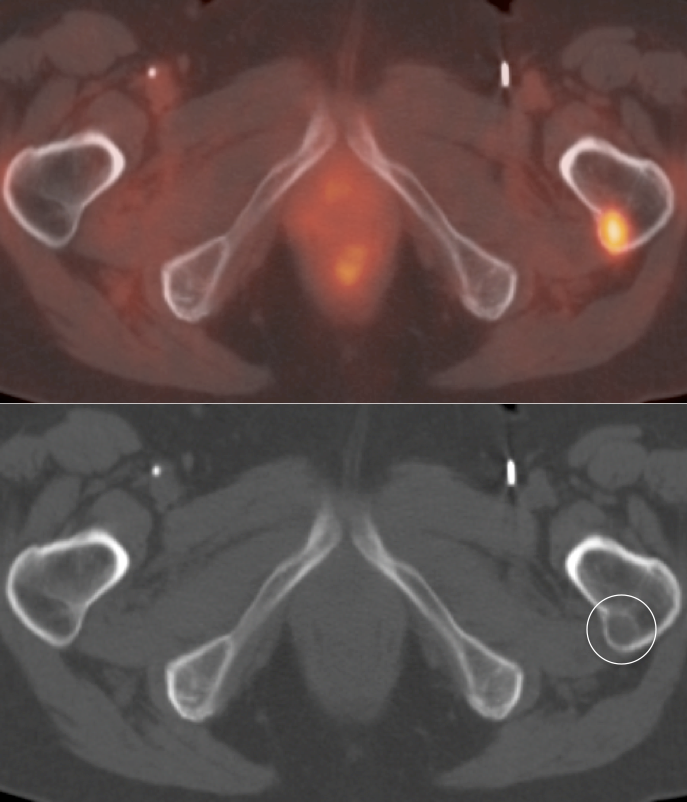
Intensely avid lytic lesion of the left femur, consistent with an osseous metastasis.

Case 8 (Image 5)
Metastatic FDG-avid lytic lesion of the left iliac bone.
Case 8 (Image 6)
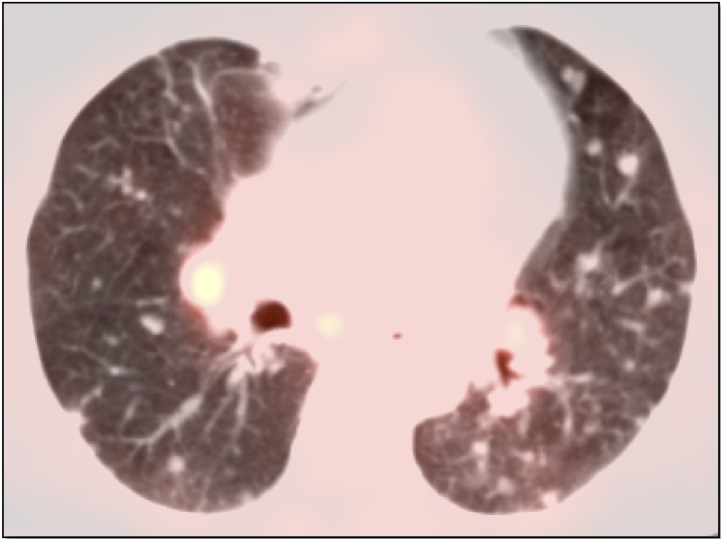
Multiple small bilateral pulmonary nodules are present. Although not significantly FDG-avid, this is likely due to their small size, which is beneath the resolution of PET. These are highly suspicious for metastatic disease.

Case 9

Case 9 (Image 2)
Marked enlargement of the left kidney, intensely FDG-avid. Also noted are FDG-avid metastases to the liver and left adrenal gland.

Case 9 (Image 3)
Large FDG-avid renal cell carcinoma.
Case 9 (Image 4)
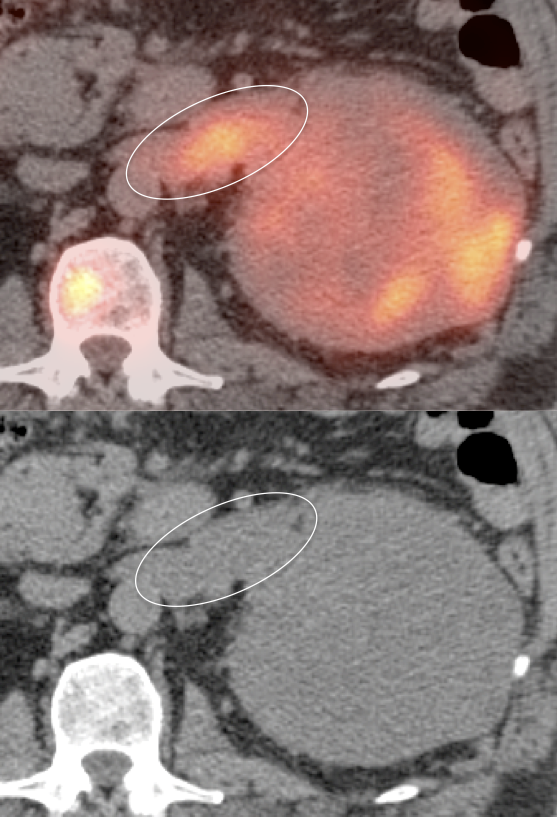
Elongated area of intense uptake in the region of the left renal vein, suspicious for tumor thrombus (confirmed at surgery).
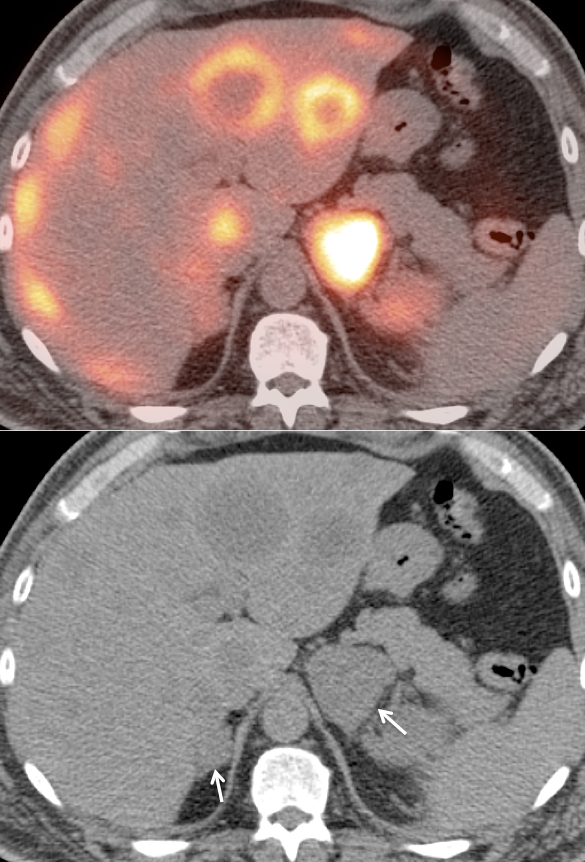
Case 9 (Image 5)
FDG-avid metastases to the liver and bilateral adrenal glands.

Case 9 (Image 6)
Pathologic fracture through an FDG-avid lytic right clavicle metastasis.

Case 10

Case 10 (Image 2)
Axial fused image demonstrates a rounded region of intense FDG uptake within the mid-pole of the left kidney. Although evaluation of the kidneys is limited without intravenous contrast, the CT image is unremarkable. Consequently, this typically represents normal pooling of FDG in a renal calyx or small caliceal diverticulum.

Case 10 (Image 3)
Coronal illustration of normal pooling of FDG in a renal calyx or small caliceal diverticulum. Note the absence of an associated soft tissue abnormality on the CT image.