Fast Facts:
Although lymphoma accounts for only about 5% of all cancers, it is the most common indication for PET/CT scanning in many radiology practices.
- Non-Hodgkin’s Lymphoma:
- 4.3% of U.S. cancers.
- Localized 5-year survival: 82%
- Distant 5-year survival: 62%
- “Aggressive” ≈ 60%
- “Indolent” ≈ 40%
- Hodgkin Lymphoma:
- 0.5% of U.S. cancers.
- Bimodal Distribution: Age 14-34 & age >55
- Localized 5-year survival: 91%
- Distant 5-year survival: 77%
Indications for PET/CT:
Initial Staging:
- PET/CT is now recommended for routine initial staging of all FDG-avid nodal lymphomas, as the “gold standard” (Lugano Criteria, September 2014).
- Permits both assessment of initial disease and serves as a baseline exam.
Assessing Response to Therapy:
- Early Response: Non-responders can be offered alternative therapy.
- Late Response: Assess success or failure of therapy, and ultimate outcome.
Recurrence & Restaging:
- Its greatest strength lies in its unique ability to distinguish residual active disease from scar tissue/post-therapeutic fibrosis — a common diagnostic dilemma in lymphoma patients.
Extra-Nodal Disease:
- Defined: Lymphomatous infiltration of anatomic sites other than lymph nodes.
- Most commonly involves the spleen, bone marrow, stomach, small bowel, Waldeyer’s ring, lung, skin, central nervous system, breast, adrenal glands, orbit and testis.
Current Criteria for “Active Lymphoma”– The Lugano Criteria:
We strongly advocate using the Lugano Criteria (September, 2014), implementing its clear and reproducible guidelines.
The Lugano Criteria modifies and expands the previously accepted Deauville Criteria (described below) to include all lymphomas, with the few exceptions of CLL/small lymphocytic lymphoma, Waldenstrom’s macroglobulinemia, mycoides fungoides and marginal zone lymphoma.
Lymph Nodes:
- If nodal activity is clearly > liver background = “Active lymphoma.”
- If nodal activity is clearly < liver uptake = “No evidence of active lymphoma.”
- If nodal activity ≅ liver, then there is likely no evidence of active disease (Deauville 3, described below). In such cases, we report, “The lack of FDG uptake significantly above background metabolic activity (as measured in the right lobe of the liver) suggests no convincing evidence of active disease. As the possibility of low-grade active lymphoma cannot be entirely excluded, follow up may be warranted.”
- Visual assessment of metabolic activity (without SUV measurements) is sufficient for both initial scans and comparison studies.
Spleen:
- If splenic uptake (focal or diffuse) is clearly > liver uptake, then we report “active lymphomatous involvement of the spleen.”
- Before calling splenic lymphoma, always first exclude a recent history of chemotherapy or colony stimulating factors.
Bone Marrow:
- If marrow uptake (focal or diffuse) is clearly > liver uptake, then we report “active lymphomatous involvement of bone.”
- Before calling marrow infiltration, always first exclude a recent history of chemotherapy or colony stimulating factors.
Lung Nodules/Masses:
- Non-avid Nodule < 8.0 mm: Considered “indeterminate, as its size is beneath the resolution of PET”.
- Non-avid Nodule > 8.0 mm: “Its lack of metabolic activity suggests a benign nodule.”
- Avidity ≤ Liver: “This may be inflammatory/infectious in nature. Active lymphomatous involvement of the pulmonary parenchyma, however, cannot be entirely excluded.”
- Avidity > Liver: “While this can be inflammatory/infectious in nature, this uptake is suspicious for active lymphomatous involvement of the pulmonary parenchyma.”
- Any new lung lesion seen at follow up is presumed inflammatory, if there has been a complete metabolic response in all other sites.
Miscellaneous Sites of Active Lymphoma:
- Solid Organ Involvement: Any focal uptake above background uptake in a solid organ is suspicious for active disease – whether or not an associated soft tissue density is apparent on the co-registered non-contrast CT images.
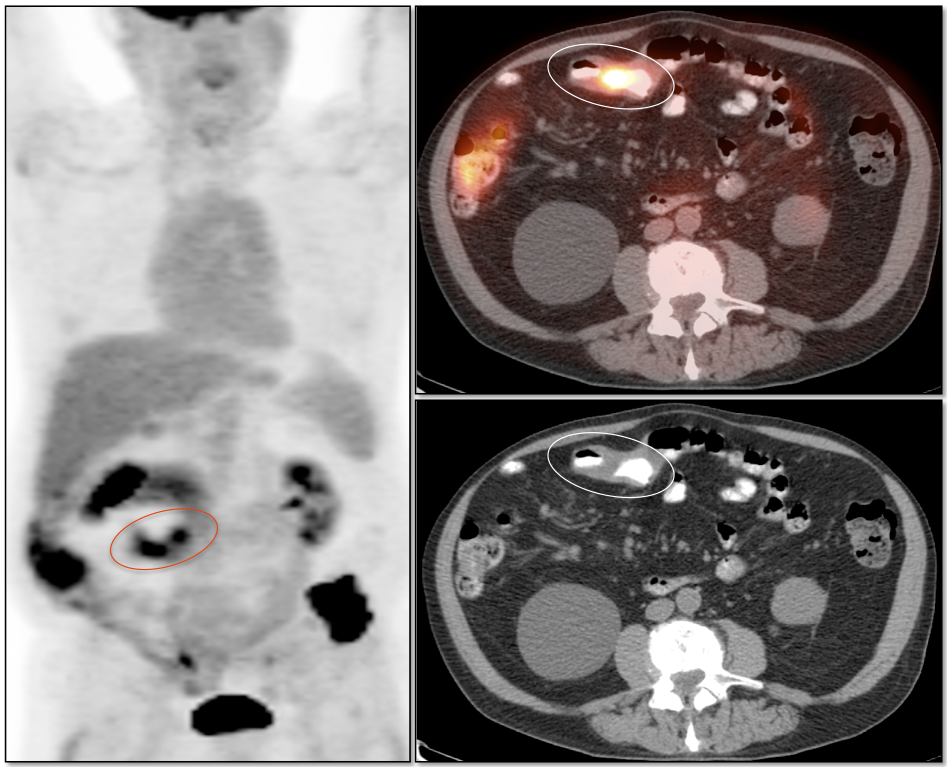
- Stomach & Bowel: The general rule of thumb is that active lymphoma is suspected if there is focal FDG soft tissue thickening with metabolic activity greater than liver background uptake.
False Positives:
Each of these topics is addressed in detail elsewhere.
- Inflammatory mediastinal/hilar nodes (here)
- Reactive Marrow (here)
- Splenic Activation (here)
- Thymic Rebound (here)
- Normal uptake in stomach, bowel & Waldeyer ring (here)
- Brown Fat (here)
- Poor Patient Preparation (here)
False Negatives:
- Low-Grade/Indolent Lymphomas: While even most indolent lymphomas demonstrate significant metabolic activity, occasionally their FDG avidity is insufficient for adequate assessment of active disease. This is especially true of CLL/small lymphocytic lymphoma, Waldenstrom’s macroglobulinemia, mycoides fungoides and marginal zone lymphoma.
- “Sponge Effect”: In some cases, circulating FDG available for tumoral uptake is decreased due to excessive FDG uptake in non-target tissues (addressed in detail, here). In the case of lymphoma, this can cause artifactually decreased uptake in both nodal and extra-nodal disease, leading to false negative results.
Reporting Language:
Clinicians (and patients) are hoping to see the following specific language as the Impression of your reports: “There is no convincing evidence of active lymphoma above or below the diaphragm.”
Caveat:
As a former professor always told his residents, “Lymphoma can look like anything!”
So if you are asked what this is:

Please feel free to suggest that it is simply a cute puppy. Lymphoma, however, should still be in your differential, because “Lymphoma can look like anything!”
Assessing Nodal Activity – A Brief & Overly-Simplified History:
Until very recently, published assessment criteria for active lymphoma focused exclusively on aggressive lymphomas. In the past few years, however, there have been dramatic changes in the criteria used to assess the metabolic activity of both aggressive and indolent lymphomas (nodal and extra-nodal disease).
Unfortunately, most radiologists are still unaware of these very important changes.
A very brief (and very simplified) chronology:
International Harmonization Project (2007):
- Active disease if uptake is greater than mediastinal blood pool, for nodes ≥ 2.0 cm.
- For nodes < 2.0 cm, any uptake above adjacent background is active disease.
- Applied only to Hodgkin lymphoma.
Deauville Criteria (2009):
- Liver replaces mediastinal blood pool as the comparative reference threshold.
- Applies only to Hodgkin lymphoma
- 5-Point Scoring System: (1-3: “Negative”; 4-5: “Active lymphoma”)
- No uptake above background
- Uptake ≤ mediastinal blood pool
- Uptake > mediastinum ≤ liver
- “Moderately” > liver
- “Markedly” > liver
Lugano Criteria (September, 2014): Described above.