

Case 1

Case 1 (Image 2)
Four cases demonstrating the typical coronal fused appearance of the colon. There are no focal hypermetabolic areas present to suggest neoplasm.

Case 1 (Image 3)
Typical axial fused appearance of the colon. While areas of ill-defined, mild to moderate FDG uptake are present, there are no focal hypermetabolic areas to suggest pathology.

Case 2

Case 2 (Image 2)
Axial fused images illustrate how intensely avid bowel can become with Metformin administration.
Case 2 (Image 3)
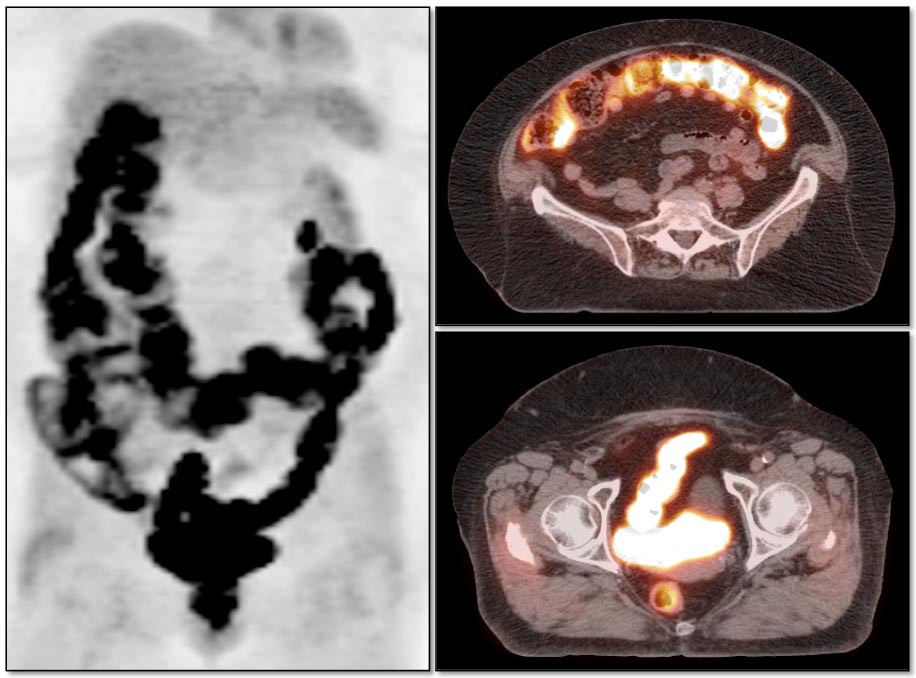
Intense uptake throughout the colon caused by Metformin. Note how the degree of intense uptake limits evaluation of the bowel for FDG-avid lesions (manually decreasing image intensity is often helpful in these cases to better assess the bowel).

Case 2 (Image 4)
Here we see intense FDG uptake involving both the large and small bowel caused by Metformin. As this uptake can limit interpretation, we ask our patients to discontinue Metformin 24-hours prior to their exam.

Case 2 (Image 5)
Metformin has caused extremely intense uptake of the bowel (small bowel > large bowel), obscuring normal pelvic structures. The degree of uptake is so extreme that the amount of remaining FDG available for uptake throughout the rest of the body is decreased, as evidenced by decreased liver uptake (“Sponge Effect”, described here).

Case 2 (Image 6)
Axial images illustrate how intensely avid bowel can become with Metformin administration (circle = large bowel; arrows = small bowel).

Case 2 (Image 7)
Axial images illustrate how intensely avid bowel can become with Metformin administration (circle = small bowel; arrows = large bowel).

Case 3
Case 3 (Image 2)
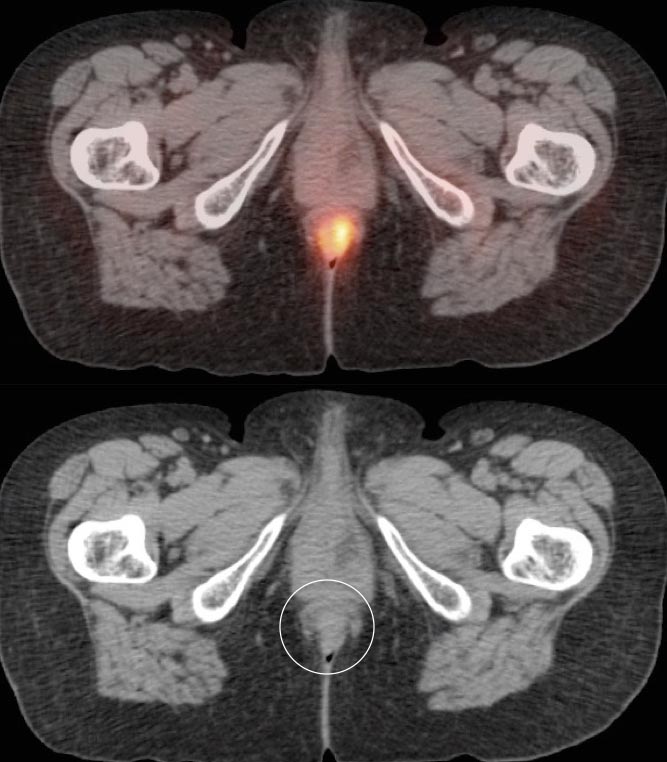
Axial fused image demonstrates intense uptake in the ano-rectal region, presumed to represent hemorrhoidal inflammation (no associated soft tissue abnormality on the co-registered non-contrast CT image).
Case 3 (Image 3)
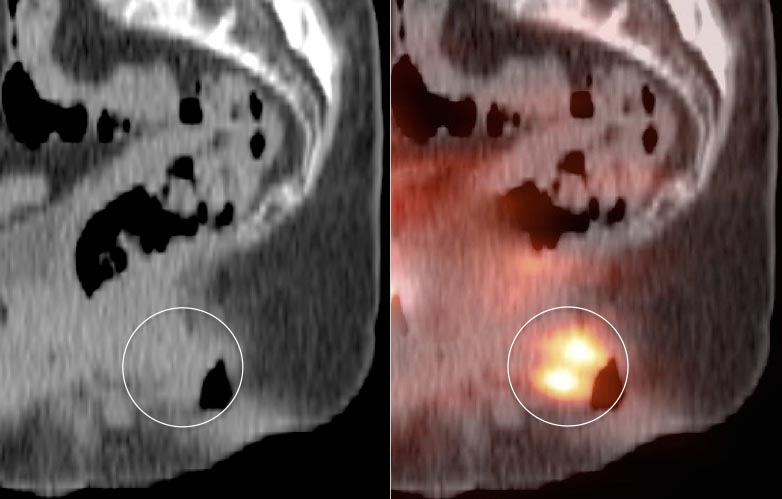
Sagittal fused image demonstrates intense uptake in the ano-rectal region, presumed to represent hemorrhoidal inflammation (no associated soft tissue abnormality on the co-registered non-contrast CT image).
Case 3 (Image 4)
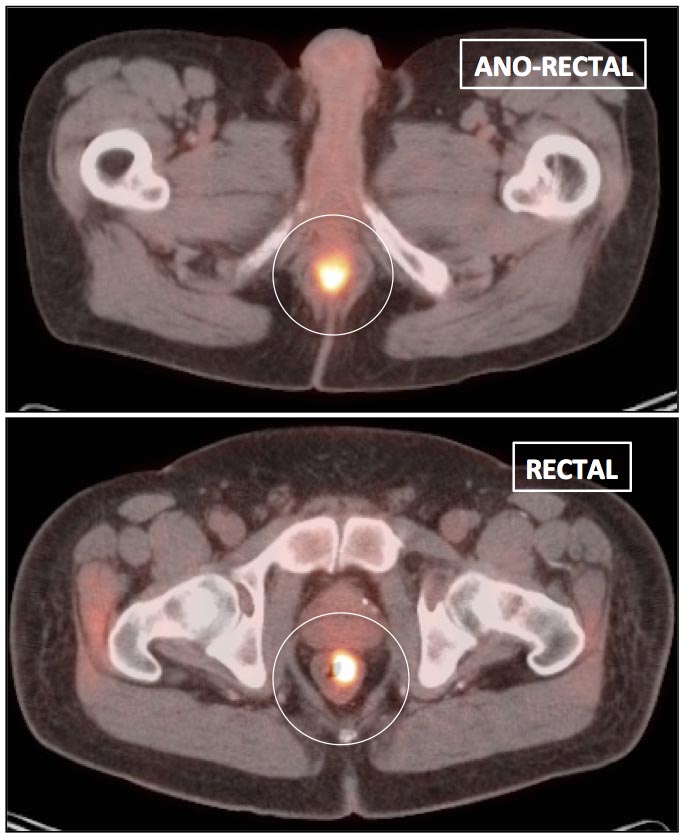
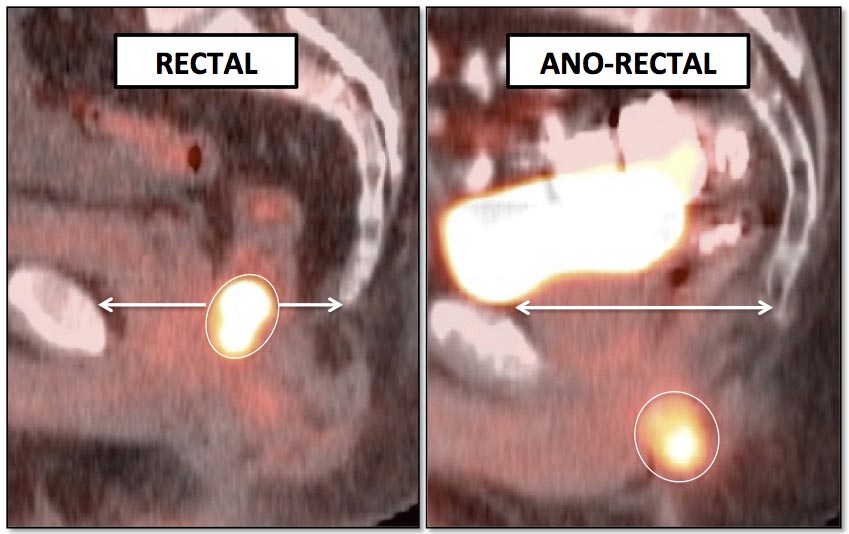
Be careful to not confuse ano-rectal uptake (typically representing hemorrhoidal inflammation) with rectal uptake (often malignancy).
Case 3 (Image 5)
Note the relationship of the coccyx to the rectum and to the ano-rectal region.

Case 4

Case 4 (Image 2)
Intense FDG uptake is noted to involve the cecum and lower ascending colon, a very common finding with PET/CT imaging. The uptake is regional rather than focal. The co-registered CT image demonstrates no associated soft tissue abnormality.

Case 4 (Image 3)
Intense FDG uptake is noted to involve the cecum, extremely focal in appearance. While this can still represent physiologic bowel uptake, its very focal nature, the lack of other areas of physiologic bowel uptake and its rather indeterminate CT appearance were concerning enough to recommend colonoscopy. Colonoscopy was completely normal.

Case 4 (Image 4)
Intense FDG uptake is noted to involve the cecum, very focal in appearance. While this PET appearance can still represent physiologic bowel uptake, focal bowel wall thickening was suggested on the co-registered CT images. Colonoscopy revealed a primary colon cancer (in this case, the metastatic liver lesions made the diagnosis easy).

Case 5
Case 5 (Image 2)
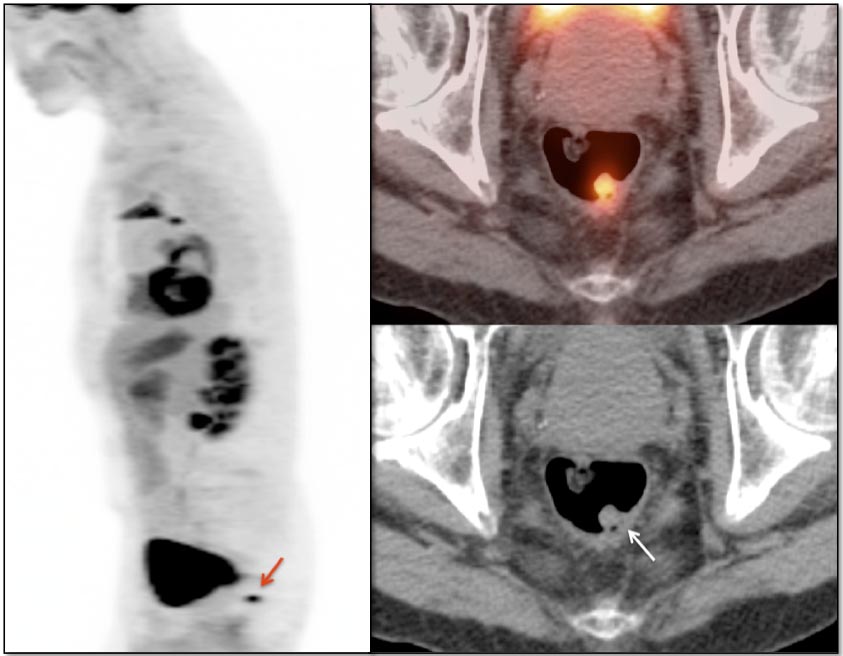
A focus of intense FDG uptake projects in the rectum, corresponding to a small nodular soft tissue density on the CT images. A hyperplastic polyp was found at colonoscopy.

Case 5 (Image 3)
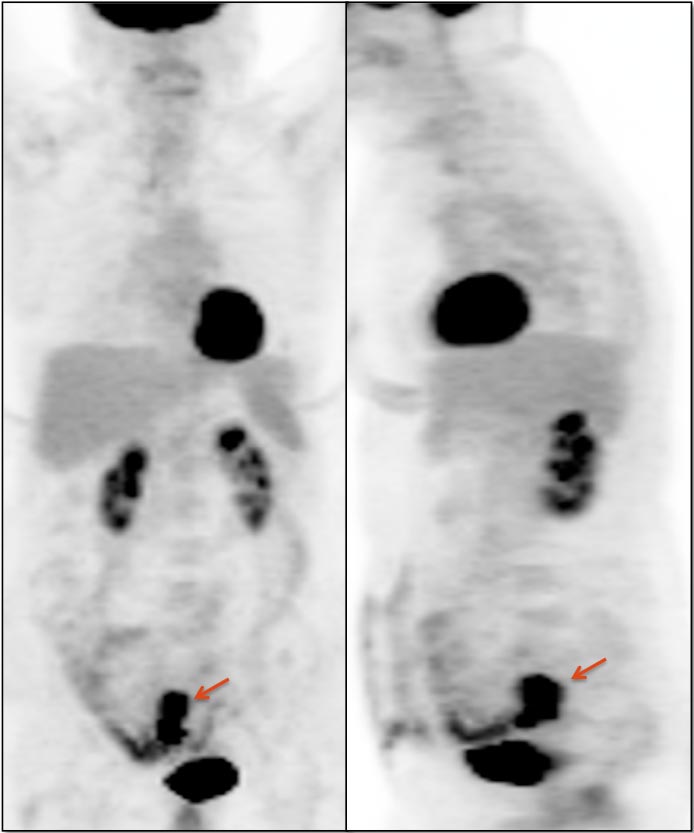
A large, intensely avid polypoid soft tissue density is noted in the rectum, found to be a malignant polyp at colonoscopy.
Case 6

Case 6 (Image 2)
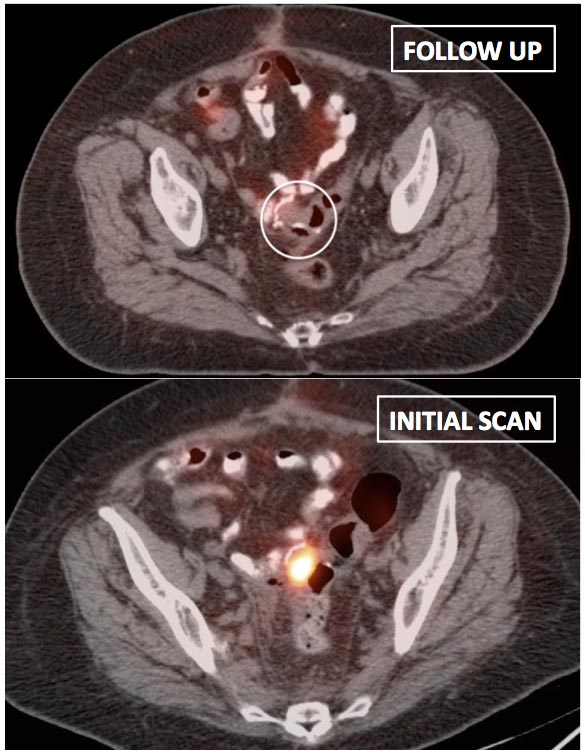
Intense focal uptake is noted to abut the patient’s anastomosis, where a focal soft tissue density is present. As this patient was only 3-weeks post-op, this FDG avid soft tissue density was presumed to reflect post-operative inflammatory changes (residual malignancy, however, could not be excluded). Follow up was recommended (See Image 3).
Case 6 (Image 3)
This image, 3-months after surgery, demonstrates complete resolution of the FDG avid soft tissue previously present at the anastomosis site, confirming the diagnosis of post-operative inflammatory changes.

Case 7

Case 7 (Image 2)
Axial images demonstrate intensely FDG-avid bowel wall thickening throughout the left colon. Its long-segment involvement is consistent with colitis, not neoplasm (in this case ulcerative colitis).

Case 8
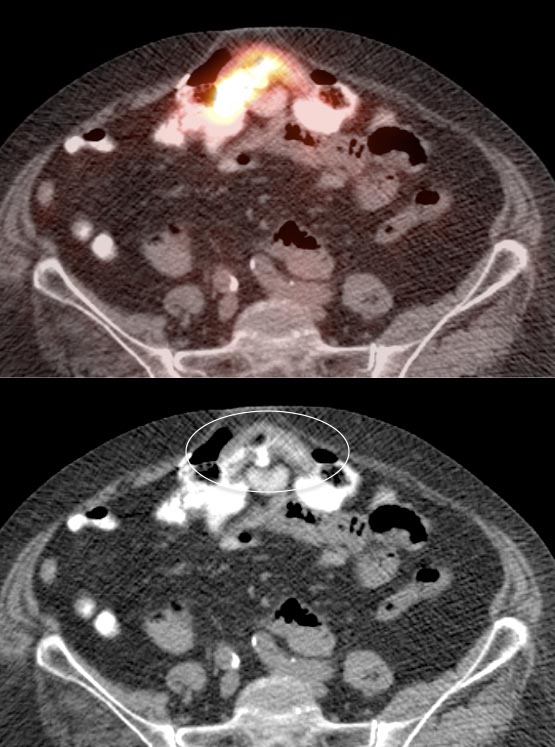
Case 8 (Image 2)
Axial images demonstrate a segment of transverse colon extending into a ventral hernia defect. Mild associated FDG-avid bowel wall thickening is present. The elongated nature of the FDG-avid wall thickening is more suggestive of inflammation than neoplasm. His clinical history was diagnostic: intermittent bowel incarceration in the ventral hernia, with subsequent acute and chronic inflammatory changes.
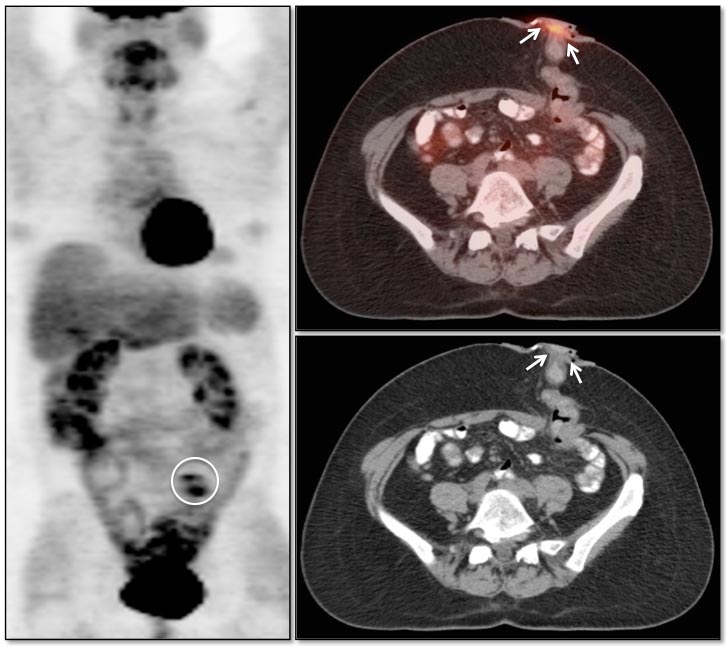
Case 9

Case 9 (Image 2)
Typical inflammatory uptake associated with an ostomy/stoma site. This stoma is 2-years post-surgery.